+11.82 pp
versus exact matched random; 95% patient-group CI [+4.00, +25.71] pp.
One eligible pathologist · 5 patient groupsA group-safe framework that ranks potentially inconsistent annotations for expert review without changing source labels.
Annotation auditing is a way to decide what a human should inspect first. It is not a way to replace the human decision.
Large histopathology datasets contain many already segmented nucleus instances, each paired with a class label. Even careful annotation can include ambiguity, inconsistent conventions or ordinary data-entry noise. Reviewing every instance again is expensive, so the useful question is not “can a model declare a label wrong?” It is “can a model create a better review queue than random sampling?”
AANCA evaluates that question under controlled conditions. It intentionally changes a known subset of class labels, hides that intervention from the auditor, and then measures whether the changed labels move toward the front of a fixed review queue. Because the benchmark records exactly what it changed, retrieval can be scored without pretending that model disagreement is biological truth.
The pre-corruption label is an experimental reference label, not guaranteed biological truth. It is used only to define the controlled benchmark, simulated restoration and final evaluation. In a real audit, a high score means recommended for expert review. It never means “confirmed error.”
JP.1, RIVA and MIDOG++ results support disagreement enrichment within their released cohorts; the earlier aggregate NuCLS ranking/downstream authority remains adverse. None establishes pathologist error, automatic correction safety or prospective workflow benefit. The PanNuke primary analysis remains exploratory because outcomes were exposed during technical recovery.Primary 5% review-queue advantages are shown separately for each natural-disagreement source. PUMA answers a different, controlled downstream question, so the four results are not pooled.
versus exact matched random; 95% patient-group CI [+4.00, +25.71] pp.
One eligible pathologist · 5 patient groupsversus exact matched random; 95% source-group CI [+1.40, +9.16] pp.
4 leave-one-annotator-out rotationsversus exact matched random; 95% image-group CI [+2.14, +13.82] pp.
2 pairwise-expert rotationsretrieval advantage [+25.93, +38.49] pp; downstream macro-F1 +0.64 pp [+0.37, +0.94].
62 held-out case/ROI groups · all 7 gates passedResponsible conclusion. The natural-data results support earlier review of independent-expert disagreements, not adjudication of who is correct. The PUMA result supports controlled-noise transfer. Neither permits automatic label changes or establishes clinical utility.
Inspect the complete external evidence and limitations ↓Verified official release; five positive nucleus classes across 19 tissue types.
Class-label consistency only. Segmentation quality and diagnosis are outside scope.
ImageNet context embeddings with balanced multinomial fitting.
A scored nucleus and its whole source patch are absent from its training fold.
Guided and random review receive the same integer budget.
The first two states show three parts kept separate for every benchmark record: the pre-corruption reference label, the observed label exposed to the model and metadata describing the controlled intervention. When corruption is injected, the observed label may be replaced and the metadata records what changed; the reference label remains fixed. It defines the benchmark target, not guaranteed biological truth.
The centre shows one of five group-safe out-of-fold splits. Four neutral folds fit the model; the violet fold contains the source group being scored. Neither that nucleus nor any other nucleus from the same source patch appears in that model's training data. Cycling the held-out fold produces one probability vector for every audited instance. The primary risk score rises as the model assigns less probability to the observed label; a higher score means earlier review, not a confirmed error.
On the right, the guided queue orders instances by risk while the random queue provides a matched baseline. Both receive exactly the same integer review budget. The five squares are schematic: the primary queue contains 5% of eligible instances, not five nuclei. Retrieval is then compared against the injected changes known only to the evaluator.
The final fork separates retrieval from downstream utility. The magnifier represents how many injected changes the queue retrieves. In the PanNuke controlled restoration experiment, only reviewed injected changes are restored, all unreviewed observed labels remain unchanged and the downstream classifier is evaluated on the untouched, uncorrupted final reference fold. Natural-data auditing never performs this restoration: AANCA only recommends potentially inconsistent annotations for expert review and never changes source annotations automatically.
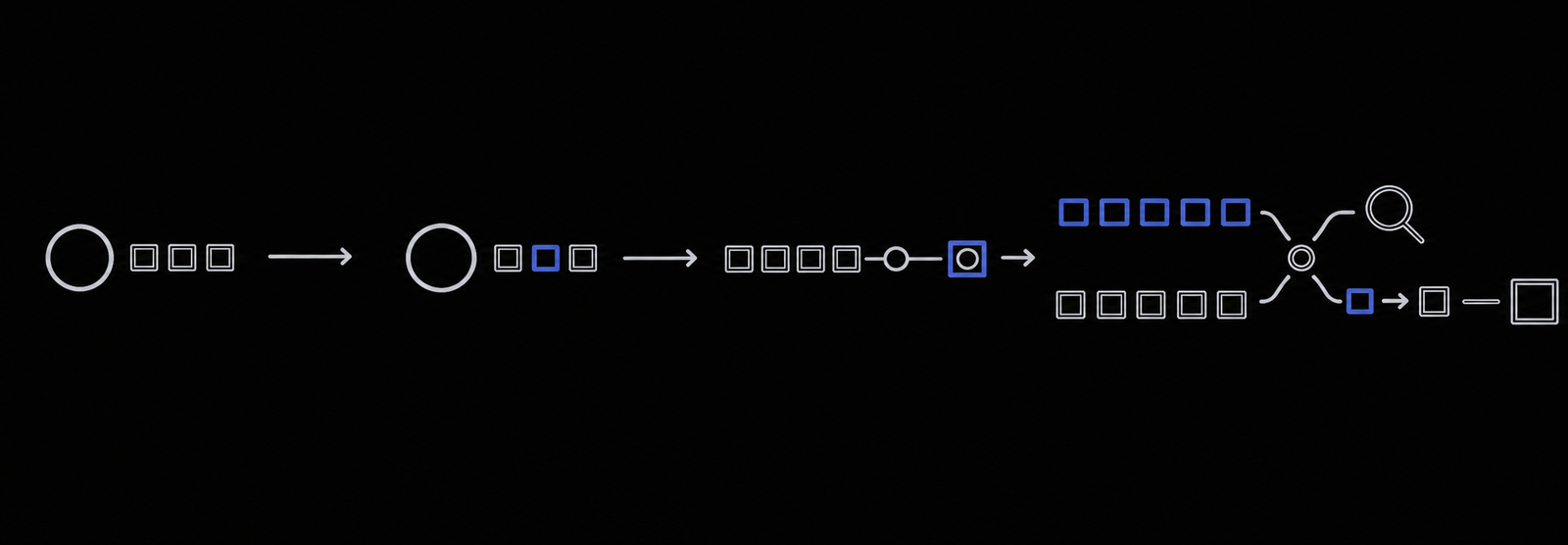
Separating them prevents a strong ranking result from being mistaken for clinical or downstream utility.
Average precision describes the complete ordering of the review queue. Recall at the primary 5% budget describes the operational slice an expert would actually inspect. The random-review baseline tells us whether that prioritisation is better than spending the same review effort without a model.
Restoration utility is deliberately separate. It asks what happens after simulated review when found injected changes are restored and the downstream classifier is retrained. A ranking can retrieve controlled inconsistencies efficiently while still failing to improve the later classifier.
Intervals and adjusted tests also answer different questions. Ranking-comparison confidence intervals use paired whole-group bootstrap resampling; registered Holm-adjusted values are one-sided. The H4 range instead contains the central 95% of differences across 100 random-review repetitions evaluated on the same fixed final reference set. It does not resample the reference groups. At 0% corruption, average precision is not applicable because the controlled positive event does not exist.
This is the most important negative PanNuke result. Ranking injected inconsistencies and improving a later classifier are related, but they are not equivalent objectives.
The H4 experiment restored exactly the same 5% review budget under audit-guided and random selection, then trained the same downstream model and evaluated it on the untouched final reference fold. Audit-guided restoration was not favoured.
Audit-guided restoration produced macro-F1 0.524431, below the random-review mean of 0.526587.
The audit-guided result was 0.216 percentage points lower. The central 95% range across random-review repetitions remained below zero on the fixed final reference set. This H4 comparison did not support downstream benefit; its range is not a group-bootstrap confidence interval.
Central 95% range [-0.002859, -0.001393] · 100 random-review repetitions on a fixed final reference set
This result does not erase the ranking evidence. It shows that retrieving more injected label changes near the front of a queue and improving final-fold classification are not interchangeable objectives. The first evaluates triage efficiency; the second depends on how the reviewed cases affect a later training distribution.
Only reviewed injected corruptions were restored; unreviewed observations remained unchanged, and all downstream conditions used the same representation, learner, seeds, review count and untouched final fold. The adverse direction is retained without selecting a post-result explanation.
The remaining registered questions
H1 through H7 were designed to separate retrieval, heterogeneity, corruption difficulty, restoration, score combination, representation availability and target highlighting. Reading them together prevents one favourable comparison from becoming the story of the entire study.
The pattern is mixed. H1 supports better-than-random prioritisation inside the controlled benchmark, H5 favours the fixed hybrid, and H3 indicates that some injected mechanisms were harder to retrieve. H4 is adverse, H7 is unresolved, and H6 is unavailable because no pathology encoder passed the frozen eligibility gates.
Each answer below states the conclusion, the exact saved evidence and the interpretation boundary. None of the positive ranking results establishes that a naturally occurring annotation is wrong.
Yes, within this controlled benchmark. Self-confidence ranking beat random review in all 12 registered comparisons: average-precision gains ranged from 0.036206 to 0.301884, and every saved 95% bootstrap interval was above zero. This means injected changes were prioritised more efficiently; it does not prove that a natural annotation is wrong. Byte-identical instance-dependent seeds are not independent replications.
Across 32,760 reportable subgroup estimates, ranking performance varied with nucleus class, tissue, corruption mechanism and corruption rate. The practical lesson is that audit difficulty depends on context. These are descriptive summaries only: the study did not register an omnibus test and cannot interpret the variation as a causal biological effect.
Confusion-targeted and instance-dependent changes were harder to rank than symmetric changes, meaning their average precision was lower. All 6 registered point differences favoured symmetric corruption; five saved 95% intervals were above zero and one crossed zero. This describes the controlled benchmark and does not establish that one natural error type is universally harder.
No. The main result above reports the complete comparison. At the same 5% review budget, audit-guided restoration was lower by -0.002156 macro-F1, so better retrieval did not translate into better downstream classification here.
Yes, for review prioritisation. The equal-weight combination of self-confidence and fold-safe nearest-neighbour disagreement outperformed self-confidence alone in all 12 registered comparisons. Average-precision gains ranged from 0.020983 to 0.065502, and every saved 95% bootstrap interval was above zero. This supports the fixed hybrid within this benchmark; it does not authorise automatic correction or diagnosis.
No result is available. None of the candidate pathology encoders passed every frozen access, licence, reproducibility, hardware and smoke-test gate, so all 3 registered H6 entries remain unavailable. They are not zero or negative results, and no substitute was selected after the other outcomes became visible.
No clear benefit was detected. Across three seeds, the average-precision differences ranged from -0.005371 to 0.002997; all 3 saved 95% intervals crossed zero, and no Holm-adjusted one-sided p-value was below 0.05. In this benchmark, explicit highlighting did not improve ranking over the context representation.
Each point is an average-precision difference; each line is its saved two-sided 95% percentile-bootstrap interval. Missing H6 points are shown as unavailable rather than as zero.
The atlas is the transition from narrative findings to detailed evidence. Rows remain grouped by hypothesis so that effect direction, interval width, unavailable cells and repeated seed structure can be inspected together instead of reduced to a single headline number.
The plot is intentionally bounded inside the article. Scrolling within it reveals all 36 registered entries while keeping the surrounding explanation in view; the complete numeric record appears later in the evidence table.
Statistical reading. Registered Holm-adjusted p-values are one-sided, while the displayed 95% intervals are two-sided summaries. Those two summaries need not produce identical verbal labels.
The saved subgroup estimates span nucleus classes, tissues, corruption mechanisms and corruption rates. They describe where performance differed in this benchmark; they do not establish a causal biological dependency.
Subgroup average precision is reported only when the preregistered support rule is met: at least 100 samples and at least 10 injected corruptions. Otherwise the study retains counts without inventing an unstable estimate.
The ranges expose heterogeneity that would disappear inside one aggregate score. They are descriptive, not a biological ranking: the preregistration did not define an omnibus test that could support a causal explanation for tissue, class, mechanism or corruption-rate differences.
32,760 reportable estimates from 33,670 saved rows. These ranges are descriptive. They are not an omnibus test or a biological ranking.
The three rows are retained for auditability, but the byte-identical files are not independent realisations and must not be interpreted as three replications.
The ranking and out-of-fold prediction files match byte for byte. The disclosure changes interpretation, not the stored record: these rows document one realisation rather than three replications.
| Seed | Cell ID | Ranking SHA-256 | OOF SHA-256 |
|---|---|---|---|
| 404 | primary_0187_53201213be77 | 69766d68a24679b5… | 730459794225e338… |
| 405 | primary_0193_afae7a244238 | 69766d68a24679b5… | 730459794225e338… |
| 406 | primary_0199_6029f5261b38 | 69766d68a24679b5… | 730459794225e338… |
Machine-readable summaries, exact identifiers and the complete 36-entry table remain available for audit. Package verification checks the published files; it does not recompute the primary study.
Every value in the article is read from the accepted sealed run and carried into evidence.json. The table below traces each statement to its hypothesis, raw identifier, seed, point difference, confidence interval, adjusted p-value and bootstrap count.
The timestamped July freeze records a null commit, a dirty tree and untracked files; the first public Git commit followed on 19 August 2026. Internal hashes preserve file identity, but the later public history is not independent evidence that outcomes were unseen.
The public primary evidence release contains all completed-cell OOF predictions and rankings, the full group bootstrap, subgroup table and H4 restoration arrays. A standalone evidence recalculator that does not import the primary analysis package recomputes the saved H1-H7 comparison statistics; this is not third-party validation. Fold checkpoints were not retained, and a second image-to-result execution still requires a lawful PanNuke copy.
| Hypothesis | Comparison | Status | Δ AP | 95% bootstrap CI | Holm-adjusted p | Iterations |
|---|---|---|---|---|---|---|
| H1 | Self-confidence vs random review · Confusion-targeted · Seed 404h1_self_confidence_minus_random_confusion_seed_404 | Reported | 0.284387 | [0.270908, 0.296645] | 0.005997 | 2,000 |
| H1 | Self-confidence vs random review · Confusion-targeted · Seed 405h1_self_confidence_minus_random_confusion_seed_405 | Reported | 0.290995 | [0.278642, 0.302825] | 0.005997 | 2,000 |
| H1 | Self-confidence vs random review · Confusion-targeted · Seed 406h1_self_confidence_minus_random_confusion_seed_406 | Reported | 0.290707 | [0.277797, 0.303165] | 0.005997 | 2,000 |
| H1 | Self-confidence vs random review · Group-conditional · Seed 404h1_self_confidence_minus_random_group_conditional_seed_404 | Reported | 0.301884 | [0.288905, 0.314960] | 0.005997 | 2,000 |
| H1 | Self-confidence vs random review · Group-conditional · Seed 405h1_self_confidence_minus_random_group_conditional_seed_405 | Reported | 0.295644 | [0.283044, 0.308389] | 0.005997 | 2,000 |
| H1 | Self-confidence vs random review · Group-conditional · Seed 406h1_self_confidence_minus_random_group_conditional_seed_406 | Reported | 0.293129 | [0.280287, 0.305916] | 0.005997 | 2,000 |
| H1 | Self-confidence vs random review · Instance-dependent · Seed 404h1_self_confidence_minus_random_instance_dependent_seed_404 | Reported | 0.036206 | [0.031088, 0.041555] | 0.005997 | 2,000 |
| H1 | Self-confidence vs random review · Instance-dependent · Seed 405h1_self_confidence_minus_random_instance_dependent_seed_405 | Reported | 0.036206 | [0.031088, 0.041555] | 0.005997 | 2,000 |
| H1 | Self-confidence vs random review · Instance-dependent · Seed 406h1_self_confidence_minus_random_instance_dependent_seed_406 | Reported | 0.036206 | [0.031088, 0.041555] | 0.005997 | 2,000 |
| H1 | Self-confidence vs random review · Symmetric · Seed 404h1_self_confidence_minus_random_symmetric_seed_404 | Reported | 0.292982 | [0.280050, 0.305129] | 0.005997 | 2,000 |
| H1 | Self-confidence vs random review · Symmetric · Seed 405h1_self_confidence_minus_random_symmetric_seed_405 | Reported | 0.298066 | [0.285532, 0.310298] | 0.005997 | 2,000 |
| H1 | Self-confidence vs random review · Symmetric · Seed 406h1_self_confidence_minus_random_symmetric_seed_406 | Reported | 0.301792 | [0.288646, 0.314714] | 0.005997 | 2,000 |
| H3 | Symmetric vs confusion-targeted corruption · Seed 404h3_symmetric_minus_confusion_seed_404 | Reported | 0.008595 | [0.000099, 0.016694] | 0.047976 | 2,000 |
| H3 | Symmetric vs confusion-targeted corruption · Seed 405h3_symmetric_minus_confusion_seed_405 | Reported | 0.007071 | [-0.000892, 0.014935] | 0.047976 | 2,000 |
| H3 | Symmetric vs confusion-targeted corruption · Seed 406h3_symmetric_minus_confusion_seed_406 | Reported | 0.011085 | [0.002823, 0.019583] | 0.010495 | 2,000 |
| H3 | Symmetric vs instance-dependent corruption · Seed 404h3_symmetric_minus_instance_dependent_seed_404 | Reported | 0.256775 | [0.242522, 0.270189] | 0.002999 | 2,000 |
| H3 | Symmetric vs instance-dependent corruption · Seed 405h3_symmetric_minus_instance_dependent_seed_405 | Reported | 0.261788 | [0.248217, 0.275018] | 0.002999 | 2,000 |
| H3 | Symmetric vs instance-dependent corruption · Seed 406h3_symmetric_minus_instance_dependent_seed_406 | Reported | 0.265437 | [0.251198, 0.279251] | 0.002999 | 2,000 |
| H5 | Fixed hybrid vs self-confidence · Confusion-targeted · Seed 404h5_hybrid_minus_self_confidence_confusion_seed_404 | Reported | 0.052548 | [0.046700, 0.058534] | 0.005997 | 2,000 |
| H5 | Fixed hybrid vs self-confidence · Confusion-targeted · Seed 405h5_hybrid_minus_self_confidence_confusion_seed_405 | Reported | 0.054609 | [0.048486, 0.061070] | 0.005997 | 2,000 |
| H5 | Fixed hybrid vs self-confidence · Confusion-targeted · Seed 406h5_hybrid_minus_self_confidence_confusion_seed_406 | Reported | 0.054104 | [0.048107, 0.060500] | 0.005997 | 2,000 |
| H5 | Fixed hybrid vs self-confidence · Group-conditional · Seed 404h5_hybrid_minus_self_confidence_group_conditional_seed_404 | Reported | 0.060268 | [0.053809, 0.066753] | 0.005997 | 2,000 |
| H5 | Fixed hybrid vs self-confidence · Group-conditional · Seed 405h5_hybrid_minus_self_confidence_group_conditional_seed_405 | Reported | 0.065135 | [0.058752, 0.071457] | 0.005997 | 2,000 |
| H5 | Fixed hybrid vs self-confidence · Group-conditional · Seed 406h5_hybrid_minus_self_confidence_group_conditional_seed_406 | Reported | 0.065502 | [0.058992, 0.071871] | 0.005997 | 2,000 |
| H5 | Fixed hybrid vs self-confidence · Instance-dependent · Seed 404h5_hybrid_minus_self_confidence_instance_dependent_seed_404 | Reported | 0.020983 | [0.018483, 0.023472] | 0.005997 | 2,000 |
| H5 | Fixed hybrid vs self-confidence · Instance-dependent · Seed 405h5_hybrid_minus_self_confidence_instance_dependent_seed_405 | Reported | 0.020983 | [0.018483, 0.023472] | 0.005997 | 2,000 |
| H5 | Fixed hybrid vs self-confidence · Instance-dependent · Seed 406h5_hybrid_minus_self_confidence_instance_dependent_seed_406 | Reported | 0.020983 | [0.018483, 0.023472] | 0.005997 | 2,000 |
| H5 | Fixed hybrid vs self-confidence · Symmetric · Seed 404h5_hybrid_minus_self_confidence_symmetric_seed_404 | Reported | 0.062592 | [0.056457, 0.068956] | 0.005997 | 2,000 |
| H5 | Fixed hybrid vs self-confidence · Symmetric · Seed 405h5_hybrid_minus_self_confidence_symmetric_seed_405 | Reported | 0.064366 | [0.057757, 0.070856] | 0.005997 | 2,000 |
| H5 | Fixed hybrid vs self-confidence · Symmetric · Seed 406h5_hybrid_minus_self_confidence_symmetric_seed_406 | Reported | 0.064656 | [0.058361, 0.071218] | 0.005997 | 2,000 |
| H6 | Pathology encoder vs ImageNet · Seed 404h6_pathology_minus_imagenet_seed_404 | Unavailable | Unavailable | Unavailable | Unavailable | 0 |
| H6 | Pathology encoder vs ImageNet · Seed 405h6_pathology_minus_imagenet_seed_405 | Unavailable | Unavailable | Unavailable | Unavailable | 0 |
| H6 | Pathology encoder vs ImageNet · Seed 406h6_pathology_minus_imagenet_seed_406 | Unavailable | Unavailable | Unavailable | Unavailable | 0 |
| H7 | Target-highlighted vs context · Seed 404h7_highlighted_minus_context_seed_404 | Reported | 0.002997 | [-0.005062, 0.010787] | 0.722639 | 2,000 |
| H7 | Target-highlighted vs context · Seed 405h7_highlighted_minus_context_seed_405 | Reported | -0.000004 | [-0.008175, 0.008265] | 0.964518 | 2,000 |
| H7 | Target-highlighted vs context · Seed 406h7_highlighted_minus_context_seed_406 | Reported | -0.005371 | [-0.013518, 0.003130] | 0.964518 | 2,000 |
Statistical note. Holm-adjusted p-values are the registered one-sided tests. The saved 95% confidence intervals are percentile-bootstrap summaries based on whole-group resampling.
Grouping follows the strongest identifiers available per dataset. No result is promoted beyond the grouping and reference-label evidence that the source actually provides.
Both sources were evaluated with the frozen candidate and a public pre-reference scoring record.
Later evidence changes the overall assessment without rewriting adverse PanNuke H4 or the earlier negative NuCLS downstream result. Each study answers a different question and keeps its own frozen boundary.
The earlier NuCLS aggregate NP/P experiment did not satisfy its frozen ranking gate and guided intervention made downstream macro-F1 worse. A separate leave-one-pathologist-out analysis then used raw JP.1 annotations as input, removed JP.1 from the hidden reference and compared the frozen global risk ranking with exact matched random review. Its five-patient ranking gate passed. Only this junior pathologist had sufficient public raw geometry and patient groups, so the result is one rotation rather than a pooled pathologist estimate.
The next public replication separated scoring from reference evaluation and published the sealed pre-reference scores first. It then passed both frozen gates on RIVA cervical cytology and MIDOG++ mitosis annotations, with positive aggregate whole-group intervals and non-negative point differences in all six rotations. MoNuSAC showed strong controlled retrieval but no statistically supported downstream gain or complete class safety. The selected AANCA candidate was later recorded internally as frozen before PUMA outcomes and passed all seven internally pre-specified gates under controlled corruption.
Public-history limit. The RIVA x MIDOG++ pre-reference scores were committed and pushed before reference evaluation, providing a public ordering record for this replication. By contrast, the PUMA protocol, configuration and result first appeared together in public commit c5bd44193b2abd67bc7e7f1bd9384aa87435d500. The NuCLS LOO protocol and execution likewise share one repository change. The PUMA readback does not retrain all 44 models. These are project-maintained verification paths, not third-party validation.
On 5 patient groups and 811 nuclei, average precision was 0.073489. Precision at the 5% review budget was 0.097561, but its difference-from-prevalence interval crossed zero. Guided correction reduced macro-F1 by 0.014633, with a 95% interval [-0.026683, -0.002415]. The frozen natural-data claims were not supported.
For the only qualifying input annotator, JP.1, AANCA reviewed
45 of
898 binary-reference-eligible nuclei
at the frozen 5% budget. Disagreement precision was
0.333333 versus
0.215111 across 100 disjoint
exact matched-random queues. The difference was
+0.118222, with a patient-bootstrap
95% interval [+0.040000,
+0.257143]. Enrichment was
1.549587x
[1.073620,
10.000000]; the frozen ranking gate passed. The input
pathologist was absent from the reference and aggregate P-truth was not used.
This supports disagreement enrichment for one junior pathologist across five
patients, not adjudicated error, multi-pathologist generalisation, deployment
queue validation or downstream utility.
The frozen candidate was scored and published before either reference was opened. At the 5% budget, RIVA precision was 0.476357 versus 0.426900 for 100 exact matched-random queues: a +0.049457 difference with a 95% whole-group interval [+0.014037, +0.091632]. MIDOG++ precision was 0.325967 versus 0.249392: a +0.076575 difference [+0.021352, +0.138159]. All four RIVA leave-one-annotator-out rotations and both MIDOG++ pairwise-expert rotations were non-negative, so both frozen gates passed. This supports cross-dataset enrichment for natural independent-expert disagreement in these public releases; it does not establish adjudicated pathologist error, downstream utility or clinical performance.
The frozen queue found 1,035 of
2,961 injected changes:
precision 0.698852 versus
0.556009 for matched
random review, with a positive difference interval
[0.099181, 0.188491]. Downstream
macro-F1 changed by +0.005526
[-0.001506, +0.012833], so the
benefit and class-safety gates failed. The prescribed action remained
retain_uncorrected.
The candidate was recorded internally as frozen before PUMA outcomes;
public Git history does not independently verify that timing. It was evaluated on
62 held-out case/ROI groups from an AANCA-defined
144/62 split of the 206 public ROIs, not the official hidden PUMA challenge
test set. Queue precision was
0.537739 versus
0.214379; the difference was
+0.323359
[+0.259251, +0.384944]. Candidate macro-F1
was 0.646310, improving on unchanged
labels by +0.006426
[+0.003657, +0.009365] and matched random by
+0.008067
[+0.004093, +0.011947]. All seven internally
pre-specified gates passed. The flag_exclude arm omitted the
highest-ranked 5% of controlled training rows; they were not reviewed,
corrected or automatically relabelled by an expert. This supports
controlled-noise transfer only.
All 9 of
9 post-confirmation PUMA stress scenarios had a
positive aggregate downstream lower bound, but only
1 passed every class safeguard.
The puma_audit_time_label_sensitivity_v1 observed-label
fold-allocation sensitivity passed all seven gates, but it was run after
PUMA outcomes were open. Paired pre/post expert-review NuCLS evidence remains
unavailable, so the binding action is still
retain_uncorrected.
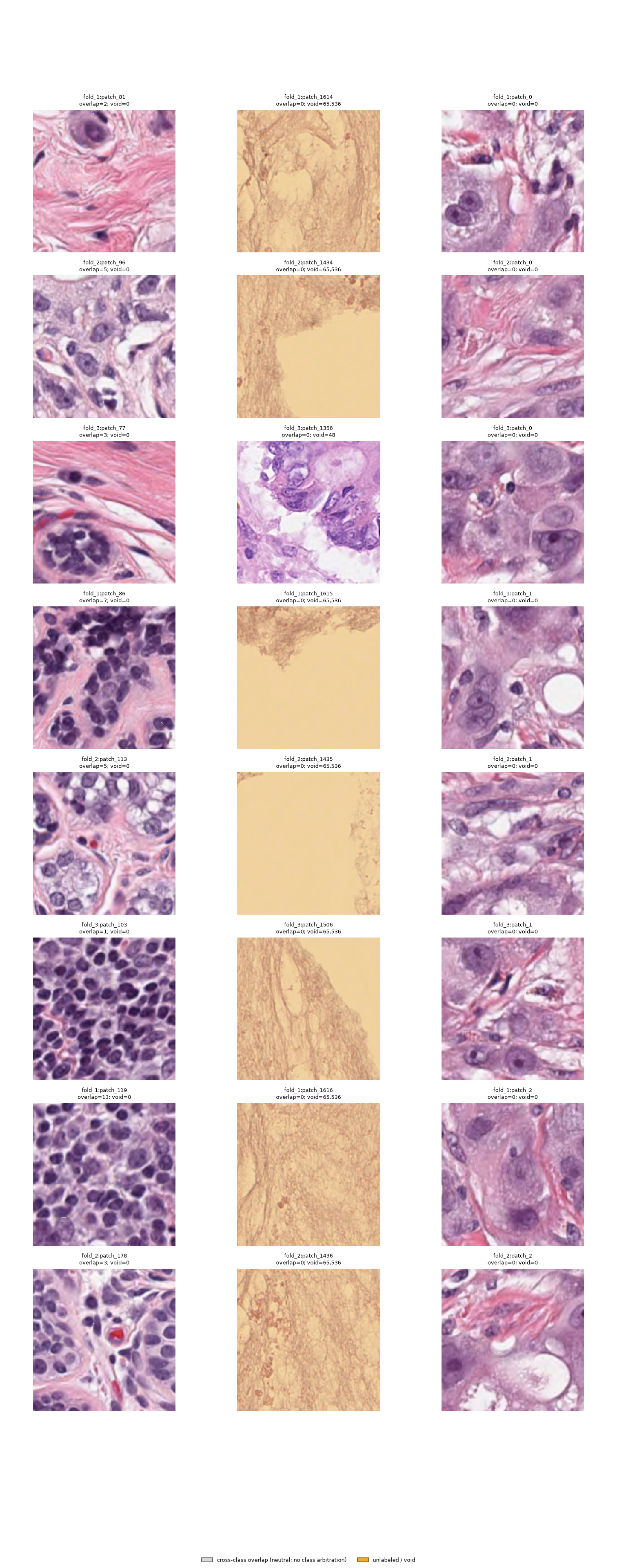
The validator measured cross-class overlaps and unlabeled regions, retained them in provenance and applied one frozen eligibility policy. It never arbitrated an overlap class or reconstructed the supplied background.
Before any primary split is frozen, the inspector verifies folds, shapes, channels, class order, instance identifiers and representative overlays. Cross-class overlaps, void pixels and affected instances are recorded rather than silently corrected.
The overlay is evidence about ingestion and representation, not improved segmentation. Eligibility flags may follow the frozen policy, but the raw masks and source annotations remain unchanged.
The model, split, feature and statistical rules were frozen before outcome interpretation. Because outcomes were later exposed during recovery, this accepted result is reported as exploratory rather than as an untouched confirmatory analysis.
Source groups stay together, each audit score is out of fold, the final reference fold is withheld from selection, and every label state remains separate. The matrix retained all 36 comparison entries; unavailable optional pathology cells were not replaced with estimates.
Outcome exposure during technical recovery does not change the stored measurements, but it narrows what can responsibly be claimed. The accepted primary analysis is therefore permanently described as amended and exploratory.
Every split uses group_id, at least at source-patch level, never individual nuclei.
Primary model-based audit scores come from predictions made for source groups excluded from model fitting.
The final reference fold is uncorrupted and unavailable for model selection, calibration or review-budget tuning.
pre_corruption_label, observed_label, is_injected_corruption and corruption metadata remain distinct.
A technically strong audit can still be limited in scope. The boundary below is part of the result, not a disclaimer added afterward.
The controlled positive event is an injected label change. Performance against it measures retrieval of that injected process, not naturally occurring annotation inconsistency or biological truth. The NuCLS and RIVA LOO positive events are strict-consensus disagreement after removing the input pathologist; MIDOG++ uses the other independent expert label. These references measure disagreement enrichment, not adjudicated error. The positive PUMA result is a new-source controlled transfer result, while its later stress and observed-label sensitivity analyses are exploratory because outcomes were already open.
Grouping strength differs by source: the primary PanNuke study guarantees source-patch separation, both NuCLS evaluations and MoNuSAC use patient groups, RIVA uses source-image groups, MIDOG++ uses image groups, and PUMA uses one ROI per case. These safeguards reduce leakage but do not transform a consensus or expert reference label into guaranteed biological truth.
Broader natural and operational validity still requires newly recruited blinded reviewers, ambiguity and abstention labels, a prospectively frozen policy evaluated on untouched patients or whole slides, and a multi-site comparison of work with and without AANCA.
JP.1 cohort, the frozen global risk ranking enriched independent-pathologist disagreement relative to exact matched random review.Completion labels describe which governed evaluations ran. They do not turn a mixed result into efficacy.
The current project has reached PRIMARY_STUDY_COMPLETE, EXTERNAL_VALIDATION_COMPLETE and DEMO_COMPLETE. It has not reached CONFIRMATORY_COMPLETE. The binding natural-data action is retain_uncorrected: AANCA may prioritise cases for qualified review, but it may not silently exclude, relabel or overwrite them.
The next research phase is provisionally named AANCA v2. This is a prospective evidence programme for the same core auditing system, not a retroactive rename of the existing results. Opened PanNuke, NuCLS, MoNuSAC, PUMA, RIVA and MIDOG++ outcomes may inform diagnosis of weaknesses, but they cannot serve as the untouched final confirmation for the next claim.
Recruit independent blinded pathologists on new cases and preserve agreement, disagreement, ambiguity, abstention and insufficient-context outcomes instead of forcing one truth label.
Develop the review queue inside nested patient- or WSI-group cross-fitting using both inconsistency probability and conservatively estimated downstream benefit.
Freeze one representation, queue, intervention, review budget, class-safety rule and analysis plan before inspecting any new confirmation outcome.
Run one-shot external validation on new patient or WSI groups. Ranking, downstream confidence intervals, every-class safety and convergence must all pass together.
Compare blinded multi-site review with and without AANCA, measuring time, agreement, accepted corrections, downstream performance and failure modes.
Only the full sequence can support a claim about realistic natural-case improvement. Until then, AANCA remains a non-diagnostic expert-review prioritisation prototype.
The checked-in article opens without a dataset, model run or GPU. present_demo.py --verify-only verifies the thirteen-file presentation package and its current PanNuke, NuCLS, MoNuSAC, PUMA, RIVA and MIDOG++ summaries; it does not retrain a model or recalculate a scientific result. The separate synthetic path exercises the portable software workflow.
The public repository retains frozen protocols, configs, compact results and arrays for scoped evidence verification. The public RIVA x MIDOG++ replication preserves pre-reference score seals and deterministic post-reference recalculation. The primary, both NuCLS analyses and MoNuSAC provide scoped metric recalculation or evidence-readback scripts. The PUMA readback imports maintained helpers and checks stored predictions rather than independently retraining the 44 models. Full image-to-result replication still requires lawfully obtained source datasets and appropriate compute; the project never downloads protected data silently or relaxes scientific gates when an input is unavailable.
The repository contains the scientific specification, maintained source code, frozen study configs, scoped verification scripts, compact evidence and this checksum-verifiable presentation. Licensed raw datasets, reusable local embeddings and unretained historical checkpoints are deliberately excluded.
Check the package, serve it locally and open the article.
git clone https://github.com/Jaqwilk/AANCA.git
cd AANCA
python scripts/present_demo.py
Validate the presentation package without recomputing the study.
python scripts/present_demo.py --verify-only
Exercise the software with deterministic synthetic data.
uv sync --dev
uv run histo-audit doctor
uv run histo-audit data generate-synthetic --config configs/smoke.yaml
uv run histo-audit experiment smoke --runs-root artifacts/smoke_runs
Real PanNuke runs require a lawful local dataset and the governed setup in DATASET_SETUP.md.